
What Is Cloud Computing Security?
Cloud Security Challenges is a unique set of guidelines, processes, controls, and technologies that help organisations safeguard their data and applications. Due to technological advances, many organisations have adopted cloud computing. They become exposed to cloud computing security threats.
Cloud Security Challenges involves measures to protect data stored in cloud environments against data leakage. It employs techniques like network security, firewalls, encryption, and identity management in order to create a secure boundary around the data.
Key Cloud Security Challenges
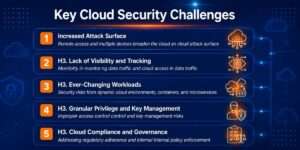
Increased Attack Surface
Today, many organizations are embracing the cloud for storing their data and performing their activities. In doing this, the scope of malicious activity has been widened.
A single click, an inappropriate password, or anything that may allow the attackers to gain access to the cloud infrastructure and exploit its vulnerabilities. Hence, the adoption of proper cloud security solutions becomes highly essential at this point, the one which will protect their data from misconfigurations and data breaches.
Lack of Visibility and Tracking
Real-time monitoring and detection are essential for cloud security. However, cloud platforms usually do not have visibility, making it difficult for organizations to monitor the movement of their data on cloud service platforms and deal with any unauthorized access to their data. As a result of limited visibility, many dangers may be overlooked.
Organizations must take advantage of intelligent AI-based analytics technology to improve threat detection capabilities.
Ever-Changing Workloads
The cloud environment is constantly changing, with workloads constantly moving. Such constant changes bring with them increased security concerns. This means that businesses should look to implement security measures that can ensure the protection of the data against any changes brought about by the constant changes in the cloud environment.
Security tools for the Cloud should be able to ensure the protection of workloads regardless of their location and status. It becomes even more difficult when containerization and microservices are added to the system.
Granular Privilege and Key Management
A sound Cloud security infrastructure hinges on the accurate allocation of granular permissions and encryption keys. Failure to properly monitor and control permissions could result in data breaches, while poor key management compromises confidentiality.
Access management solutions are vital in providing granular permissions in accordance with roles and duties. Organizations should leverage automation and zero trust principles when granting access to cloud infrastructures.
Cloud Compliance and Governance
Cloud Compliance refers to adherence to external legal policies, while governance concerns the enforcement of internal policies. Compliance in the fast-changing cloud computing world requires tracking regulatory changes. Governance allows one to simplify cloud security policies, audits, and risks management.
This is achieved using automated compliance tools that help assess risks, conduct live security audits, manage compliance and policy enforcement. A lack of cloud compliance and governance may result in fines and data confidentiality breaches.
Common Types of Cloud Security Solutions
Security Information and Event Management (SIEM)
Security information and event management (SIEM) tools provide real-time analysis of cloud security of an organization by gathering, correlating, and analyzing data gathered from network devices and applications. These tools play a significant role in detecting potential threats, addressing them, and ensuring compliance.
A successful implementation of security information and event management tool would help organizations identify any suspicious activities related to their cloud security and trigger automated actions based on those events. They cover both hybrid and multi-cloud environments by utilizing the power of artificial intelligence and machine learning.
Cloud Workload Protection Platform (CWPP)
More than 94% of organizations are moving into cloud environments, which makes the workload high. A cloud workload protection platform ensures visibility and threat protection through runtime protection of all cloud environments for the organization. This helps to prevent any cloud security issues with regard to the workload, including misconfiguration and unauthorized access.
Cloud workload protection platforms include application-layer controls and protection against vulnerabilities. Using these platforms ensures automated response and threat detection without impacting the application’s performance.
Cloud Security Posture Management (CSPM)
CIEM tools aid in managing cloud infrastructure permission entitlements. Any single act of unauthorised access may cause data leakages and misconfiguration in the cloud. Therefore, the use of CIEM tools enables access governance within cloud environments, promoting identity governance and compliance.
In this regard, CIEM tools provide assistance in identifying permission gaps in business organizations and offer recommendations on how to mitigate them.
Cloud Infrastructure Entitlement Management (CIEM)
CIEM tools aid in managing cloud infrastructure permission entitlements. Any single act of unauthorised access may cause data leakages and misconfiguration in the cloud. Therefore, the use of CIEM tools enables access governance within cloud environments, promoting identity governance and compliance.
In this regard, CIEM tools provide assistance in identifying permission gaps in business organizations and offer recommendations on how to mitigate them.
Cloud-Native Application Protection Platform (CNAPP)
All cloud-native app platforms concentrate on bringing together all cloud security solutions in order to ensure the security of cloud workloads. This gives one control centre for handling security tests as well as vulnerabilities.
These CNAPPs help solve the security issues involved in cloud native application creation and management. The tool simplifies matters and also increases the effectiveness of security through policies and runtime security. Using the tool, one can secure the cloud-native applications without divulging how they have been developed.
Data Loss Prevention (DLP)
Data loss prevention technology assists in identifying and managing the data used, moved, and stored. The system ensures that no accidental leakage of data takes place through visibility and prevents any unauthorised access to it.
With DLP technology, companies get to encrypt their data automatically during any movement that is not in line with their organisation’s policy, resulting in decreased chances of data breaches.
Best Practices for Securing the Cloud
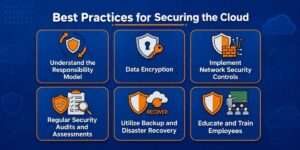
Understand the Shared Responsibility Model
The task of protecting data in the cloud environment falls on the shoulders of cloud service providers and their clients as well. This is known as the sharing of responsibilities. Though customers are to make sure that data is securely managed and that there is secure access to it, cloud providers are to take care of securing the infrastructure.
Businesses are to regularly examine and update the cloud environment. Adopting a shared responsibility model will be helpful for businesses to align cloud security strategies.
Data Encryption
Data Encryption is essentially a lock for data that keeps data locked up and inaccessible to unauthorized users. It ensures data security from any sort of cyber attack or leak. Encrypting the file helps business organizations keep sensitive and confidential information safe.
Implement Network Security Controls
Network firewalls, IDPS, and virtual private networks (VPNs) play a significant role in safeguarding networks from unauthorised access and possible dangers. The use of network security controls plays an important role in creating a secure cloud environment. Network segmentation and microsegmentation involve isolating parts of a network to avoid data breaches and other cloud security risks. Businesses should consider using a zero-trust network approach to stop unauthorised device communication
Regular Security Audits and Assessments
Security assessments and audits are critical in order to ensure a good cloud security posture. Daily security audits help identify the loopholes. misconfigurations, and policy violations. By conducting such assessments. organizations become aware of possible dangers that exist and take corrective action against them.
This enables companies to develop an adaptive security approach that provides protection from new threats.
Utilize Backup and Disaster Recovery
Using backup and disaster recovery techniques becomes very important in preventing loss of data in cloud computing systems. It involves backing up data on regular basis and ensuring the restoration of data in case of any data corruption or any hardware failures. The purpose of disaster recovery techniques is to restore data in case of disruptions, and it also helps avoid financial losses to an organization.
It helps organizations in creating backups of their data.
Educate and Train Employees
Cloud security best practices training for the staff should be provided to reduce human error in relation to security issues. Training programs increase the awareness of various types of threats that exist, proper conduct regarding security, and also the importance of the shared responsibility model. Being familiar with security procedures and the possible tricks of hackers can help employees become part of the security solution.
Training should be continuous and responsive to any new types of threats or cloud computing technology that emerges. The encouragement of a security-minded culture helps to instill a proactive attitude in staff, making them always aware of the security implications of any action they take.