
AI Performance Testing in 2026 Changes how teams create workloads and analyse results. AI can generate test scripts faster. It can identify unusual behaviour and help engineers find performance bottlenecks earlier.
How AI Is Changing Load and Performance Testing is mainly about improving speed and analysis. AI does not remove the need for performance engineers. It helps them make better decisions with less manual effort.
For SaaS platforms and ecommerce systems, AI Performance Testing in 2026: can support faster releases and more reliable user experiences. The same approach is becoming useful for fintech and large enterprise systems.
What Is AI Performance Testing?
AI performance testing uses artificial intelligence as an augmentation layer within existing performance-engineering practices. It can help teams generate test scripts and model workloads. It can also support anomaly detection and performance analysis.
AI does not replace conventional performance testing. Engineers still define realistic workloads and establish performance baselines. They also configure test environments and validate results. In practice, AI performance testing works alongside established load testing methods and tools. Modern AI performance testing tools help automate repetitive tasks and provide additional insights during these activities.
AI Performance Testing vs Traditional Performance Testing
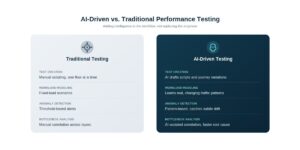
Traditional performance testing depends heavily on manual scripting and analysis. AI-powered performance testing adds automation to these activities.
The key difference in AI vs traditional load testing is the level of intelligence applied to test creation and result analysis. Traditional tools still remain important. AI improves how engineers use them.
How AI Fits Into the Performance Testing Lifecycle
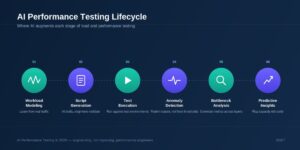
AI Performance Testing in 2026: can support almost every stage of the lifecycle. AI can help generate scripts and improve workload models. It can also analyse telemetry after a test.
This makes automated performance testing with AI useful for teams that run tests frequently. AI can also support AI automated load testing within modern CI/CD pipelines.
How AI Is Changing Load Testing in 2026
How AI Is Changing Load and Performance Testing becomes clearer when we look at the main changes in load testing.
AI-Generated Load Test Scripts
An AI load test generator can create an initial test from application flows or technical requirements. An AI load test script generator can reduce the time required to build scripts
AI test script generation for load testing can also help teams create variations of common user journeys. Engineers must still validate the generated scripts before execution.
Intelligent Workload Modeling
AI can study historical traffic patterns and application behaviour. It can then help create more realistic workload models.
This is one of the major AI load testing benefits. Teams can move beyond simple fixed-load scenarios and model changing traffic conditions.
Automated Test Optimization
AI can identify repetitive test activities and suggest optimisation opportunities. This can make AI powered load testing more efficient.
Teams can also combine AI with established load testing tools such as JMeter and k6. JMeter AI performance testing can support smarter test development. k6 AI load testing can help teams automate modern performance workflows.
AI-Based Anomaly Detection
AI anomaly detection performance testing uses patterns in telemetry to identify unusual behaviour. This can reveal sudden latency increases or abnormal resource usage.
AI can detect patterns that may not trigger traditional fixed thresholds. This makes AI performance testing tools 2026 increasingly useful for complex applications.
AI-Powered Bottleneck Identification
AI can correlate performance metrics across application layers. This can help engineers investigate CPU usage or database latency.
AI bottleneck detection can reduce the time needed to locate the likely source of a problem. It does not replace technical investigation.
Predictive Performance Analysis
AI can analyse historical test results to identify performance trends. Teams can use these insights to anticipate capacity risks.
This is an important part of AI powered performance testing. It supports earlier action before performance problems reach production.
AI Performance Testing vs Traditional Load Testing
| Area | Traditional | AI-driven |
|---|---|---|
| Test creation | Manual | AI-assisted |
| Script maintenance | Manual | AI-assisted |
| Analysis | Engineer-driven | AI-assisted |
| Anomaly detection | Threshold-based | Pattern-based |
| Bottleneck analysis | Manual correlation | AI-assisted correlation |
| Reporting | Manual | Automated |
AI performance testing vs traditional testing is not about replacing established tools. It is about adding intelligence to the testing workflow.
How AI Can Improve Enterprise Performance Testing
AI Performance Testing in 2026: can provide several practical benefits for enterprise teams.
- Faster test creation: AI can generate initial scripts quickly.
- Better workload modeling: AI can support realistic traffic patterns.
- Faster analysis: AI can highlight important performance signals.
- Earlier detection: AI can identify abnormal behaviour sooner.
- Reduced maintenance: AI can help identify script changes.
- Continuous testing: AI can support performance checks within CI/CD.
These benefits apply to enterprise AI performance testing as well as AI performance testing for SaaS. They also support AI performance testing for ecommerce and AI performance testing for fintech environments.
Limitations of AI in Performance Testing
AI is powerful but it is not infallible. AI Performance Testing in 2026: still requires human oversight.
AI may produce hallucinated recommendations. Generated scripts may contain inaccurate assumptions. An AI load test may also create an unrealistic workload if it lacks production context.
Security and privacy require attention too. Sensitive application data should not be exposed to an AI system without proper controls.
Human validation remains essential. Performance engineers must confirm that workloads reflect real users and that results have the correct technical context.
How to Implement AI-Driven Performance Testing
Performance Testing can be applied through a structured process:
- Establish a performance baseline.
- Define the workload model.
- Generate and optimise test scripts.
- Execute load tests.
- Investigate bottlenecks.
- Validate remediation.
- Integrate testing into CI/CD.
- Continuously monitor performance.
An AI load testing platform can support this workflow. An AI performance testing platform can also connect test execution with result analysis.
Why AI Does Not Replace Performance Engineers?
AI can automate repetitive work. It cannot fully understand business-critical user journeys or production architecture without the right context.
A performance engineer decides whether a workload is realistic. The engineer also validates bottleneck findings and determines whether a performance issue is acceptable.
This makes AI a force multiplier rather than a replacement. The strongest approach combines AI performance testing in 2026 with experienced performance engineering.
FAQs
How is AI used in performance testing?
AI is used for test script generation and workload modelling. It can also support anomaly detection and bottleneck analysis.
What are the best AI performance testing tools?
The best AI performance testing tools depend on the application and testing goals. Teams may use established platforms such as JMeter or LoadRunner alongside AI-assisted workflows.
Is AI load testing better than manual load testing?
AI load testing vs manual load testing is not a simple replacement decision. AI can make test creation and analysis faster. Human engineers are still needed for validation.
What is AI performance testing for SaaS?
AI performance testing for SaaS helps teams validate applications under changing traffic conditions. It can support API performance testing and microservices testing.
Can AI improve load testing?
Yes. AI can improve test generation and workload modelling. It can also support faster anomaly detection and performance analysis.
Validate Application Performance With SDET
AI can accelerate performance testing. Real-world validation still requires engineering expertise.
SDET provides performance testing services and load testing services for modern applications. Its approach can support SaaS platforms and enterprise systems across complex workloads.
Need to validate your application under real-world load? Explore SDET’s performance testing services.