
SDET Tech was initially engaged through a short Proof of Concept (POC) to evaluate the quality of a live production application as part of a broader quality engineering services assessment. What began as a small validation exercise quickly evolved into a broader initiative centered around scalable software quality engineering and long-term Quality Assurance (QA) partnership
Within the first two weeks of structured production testing, over 120 defects were identified. These findings highlighted deeper challenges related to release governance, regression validation, automation effectiveness, accessibility compliance, and performance stability within the client’s software quality engineering processes. These findings exposed gaps in the client’s existing software quality engineering practices and highlighted the need for long-term QA transformation.
Through targeted interventions including production stabilization, release process improvements, automation framework restructuring, accessibility audits, and performance validation, SDET Tech helped the client move from reactive issue management to a predictable, scalable quality engineering model. The engagement has continued successfully for over a year
Background & Engagement Context for QA Transformation
The client approached SDET Tech to conduct a short-term assessment of their production application. The objective was to evaluate system quality, identify risks, and provide recommendations through structured quality assurance services.
At the time of engagement, the application was already live. Development speed was strong, but releases were happening without a fixed structure. Automation existed, yet coverage and reliability were limited. The absence of structured quality assurance services created operational risks during frequent releases.
Initial expectations focused on validation, but early findings revealed the need for broader QA transformation and structured enterprise quality engineering practices.
Initial Observations & Key Challenges in Production Stability
During the first 1–2 weeks of structured production testing, SDET Tech identified multiple concerns affecting production stability and regression validation.
- Over 120 defects were discovered, ranging from UI inconsistencies to critical functional failures.
- Several issues directly affected real users.
- Functional gaps were observed across important workflows.
- No fixed release cycle or milestone governance existed.
- Regression validation practices were inconsistent.
- The automation framework showed low coverage and maintainability challenges.
These defects indicated underlying gaps in enterprise QA solutions and inconsistencies in release validation workflows. While development velocity was high, structured quality engineering practices required strengthening.
Quality Engineering Team Structure and Testing Strategy
To address the initial assessment and stabilization needs, Sdet Tech deployed a focused Quality Engineering team designed to cover both functional and technical testing areas through enterprise QA solutions. The testing model was designed to support end-to-end continuous quality engineering across both technical and functional validation areas.
Core QA Team: The engagement began with
1. Functional QA Engineers
Responsible for:
- End-to-end functional validation
- User workflow testing
- Defect identification and reporting
- Regression testing support
2. Automation Engineer
Responsible for:
- Evaluating the existing automation framework
- Stabilizing automated test execution
- Enhancing regression coverage
- Improving framework maintainability
Key efforts were directed toward improving framework scalability and reducing dependency on unstable test automation framework configurations.
Extended Specialist Team for Accessibility and Performance Testing
As project priorities evolved, additional specialists were onboarded as part of the broader quality engineering services engagement.
Dedicated Accessibility Engineer
Responsible for:
- Conducting WCAG-aligned accessibility audits
- Validating assistive technology scenarios
- Identifying compliance gaps
- Supporting remediation guidance
Accessibility validation activities also contributed to broader assistive technology testing and compliance with readiness initiatives.
Performance Engineer (Focused Phase Engagement)
Responsible for:
- Executing load and stress testing
- Identifying performance bottlenecks
- Validating system stability under concurrent usage
- Delivering optimization insights
The objective was to strengthen application resilience through targeted load testing services and concurrent usage validation.
Strategic Interventions
Production Stabilization and Defect Management Process
The priority was stabilizing the live production environment through structured production stabilization services.
- All defects were logged, categorized, and prioritized based on severity and business impact.
- Rapid validation cycles are supported to accelerate fixes.
- Extended working hours were provided when necessary to stabilize releases.
This phase improved visibility into production risks and enabled faster defect resolution through proactive defect management processes.
Release Governance & Structured QA Process Improvements
The absence of structured release cycles was identified as a major contributor to instability within the client’s software release management process.
SDET Tech introduced:
- Time-bound release cycles.
- Sprint-level milestones
- GitLab board tracking.
- Structured daily stand-ups
- Pre-production quality gates
These changes transformed release management from reactive firefighting to predictable, process-driven delivery supported by structured quality assurance processes.
Automation Framework Optimization for Scalable Regression Testing
Rather than replacing the automation framework, SDET Tech refactored it for improved effectiveness through automation framework optimization.
- Framework architecture was restructured.
- Modularity and maintainability were enhanced
- Coding best practices were established.
- Regression coverage was increased
- Automation was focused on critical business flows
This resulted in improved test stability, reduced maintenance overhead, and stronger regression safety through scalable automated regression testing practices
Accessibility Testing and WCAG Compliance Validation
Accessibility improvements were implemented with a dedicated specialist as part of the client’s accessibility testing services initiative.
- WCAG-aligned audits conducted.
- Assistive technology scenarios validated
- Compliance gaps identified
- Structured remediation guidance delivered
- VPAT documentation produced
This enhanced inclusivity and strengthened enterprise accessibility compliance readiness. It has also improved enterprise readiness for formal accessibility compliance validation and inclusive user experience standards.
Performance Testing and System Stability Validation
A focused performance testing phase was executed as part of the broader performance testing services strategy. We identified bottlenecks impacting overall scalability testing and platform responsiveness.
- Load and stress testing performed.
- Scalability bottlenecks identified
- Stability under concurrent usage validated
- Optimization recommendations delivered
The system’s resilience under real-world conditions was successfully validated through structured load testing and scalability testing. Performance insights helped strengthen long-term infrastructure planning and overall performance optimization strategies.
Outcomes Delivered Through Structured Quality Engineering Optimization
The engagement delivered measurable improvements through scalable quality engineering optimization:
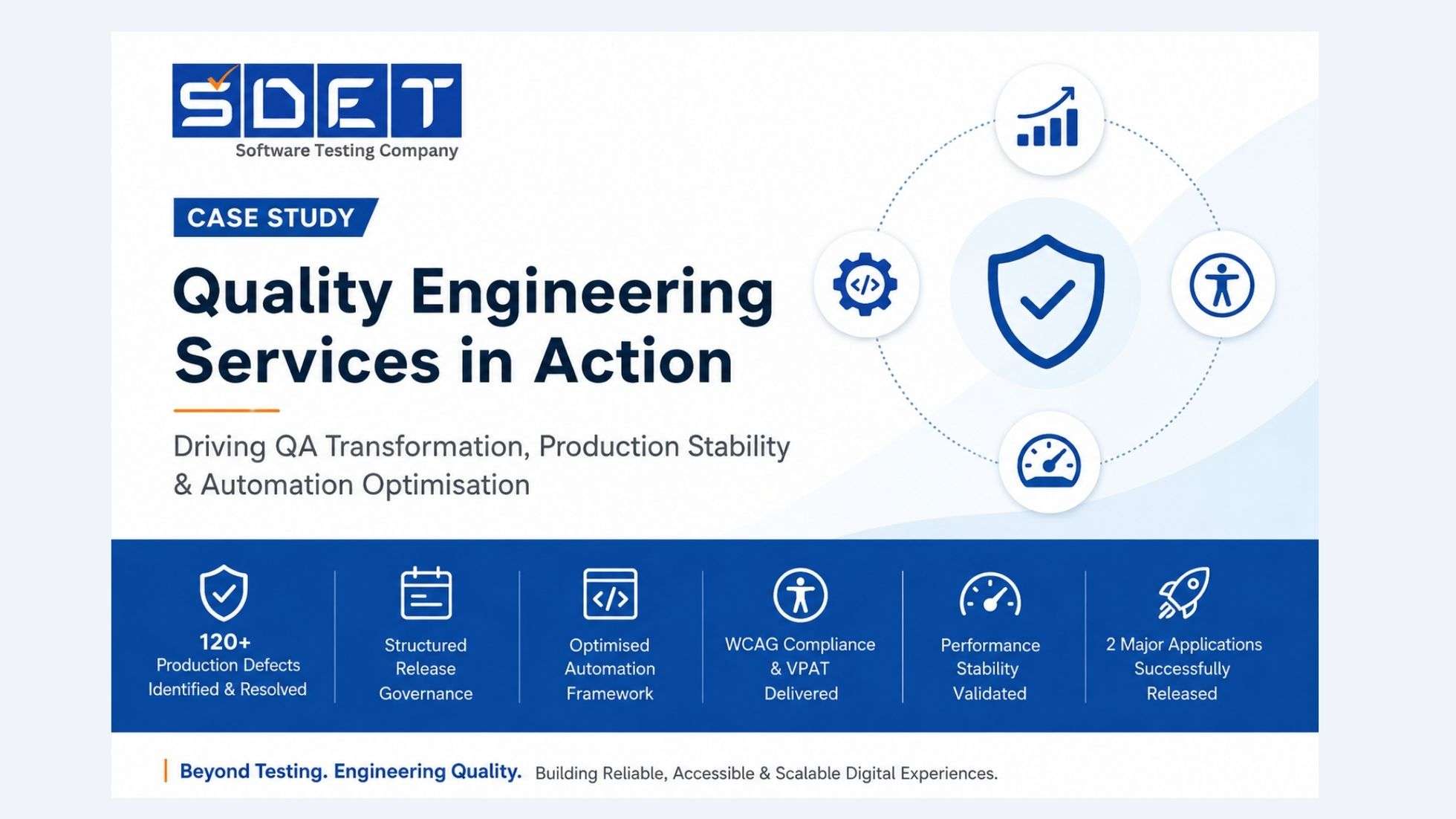
- 120+ production defects identified and addressed.
- Structured release governance established.
- Improved regression validation practices
- Enhanced automation framework stability
- Accessibility compliance validated with VPAT reports
- Performance stability confirmed under load
- Two major applications successfully released
Business Impact of Quality Engineering and QA Transformation
Beyond technical improvements, the initiative delivered broader organizational value through structured QA transformation.
- Increased release confidence
- Reduced production risks
- Improved cross-team coordination
- Enhanced user experience
- Stronger quality culture
Improved collaboration and validation of workflows contributed to more reliable software testing lifecycle management across teams.
Long-Term Quality Engineering Partnership Evolution
What began as a short POC evolved into a long-term strategic partnership exceeding one year. SDET Tech continues to support ongoing releases and quality initiatives through continuous quality engineering services. Plans include expansion into mobile testing and advanced automation scaling.
Key Takeaway on Continuous Quality Engineering
Quality is not a final checkpoint. It is a continuous engineering discipline that requires structured processes, effective automation, accessibility compliance, and performance validation as part of modern enterprise quality engineering practices.